


While the canon of art history is filled with female nudes, visions of Black femininity are largely absent. Challenging these traditional perspectives, and reframing the muse, is British-Nigerian artist Joy Labinjo whose major solo show, ‘A Place of Our Own’, has recently opened at Wolverhampton Art Gallery.
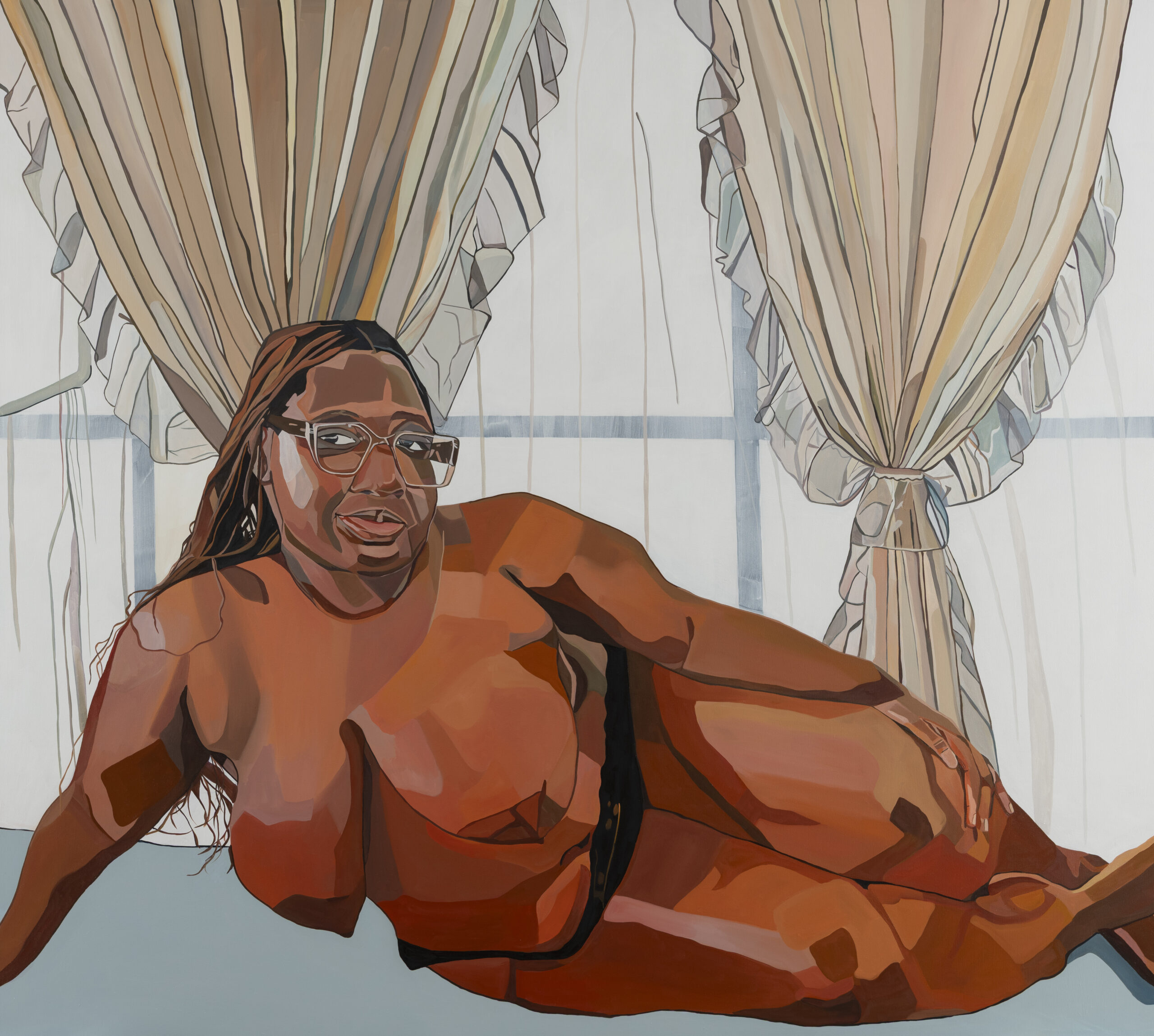
Viewers are immediately greeted by a Black woman, undressed and reclining, in a domestic space. Behind her, pastel-coloured curtains may have been drawn back, yet white netting allows only soft light to fill the room which appears safe and closed off from the outside world.
Painted in warmer, more vivid tones is the sitter, whose skin is a harmonious patchwork of browns and orange, unblended in a flattened, collage-style aesthetic. She wears a pair of full-rimmed glasses, a half-smile emerging on her face.
In this large-scale painting, Labinjo has subverted an enduring motif beloved by great male artists: the woman in the window. Replacing centuries of voyeuristic framing, Labinjo reclaims the female nude who appears at ease, gazing back with both character and confidence.
Her sitter has been identified in the work’s poetic title, ‘Deborah, veiled in morning light’, 2025. For this exhibition Labinjo worked with a circle of friends, several of them fellow artists, to create more than 20 new portraits of her subjects in their own homes or studios, where they assume unapologetic poses that assert an acceptance of self.
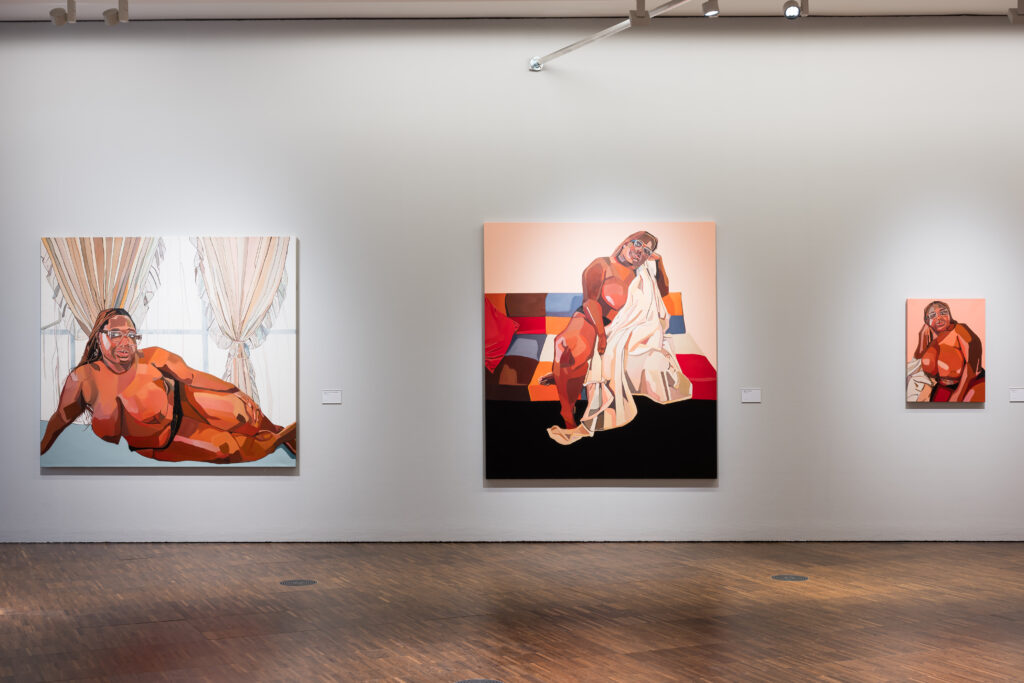
A mood of relaxation is another constant, evident in paintings such as ‘Draped in comfort’, 2025, where Deborah is seated, leaning her head on one hand. She is partially covered by a mass of cream fabric, which is a staple in the life modelling room. However, it seems to fall away from any formal position, evoking ease and trust between artist and subject who seems caught in a moment between poses.
Labinjo has treated each of her sitters with gentleness, care and consideration, honouring the vulnerability they showed her in moments of relaxation, rather than performance. In ‘A Resting Presence’, 2025, a nude lazes on a sofa of ocean blue and abstracted patterns. Hands placed across her stomach, she crosses her legs; again, this is a languid pose in an everyday space.
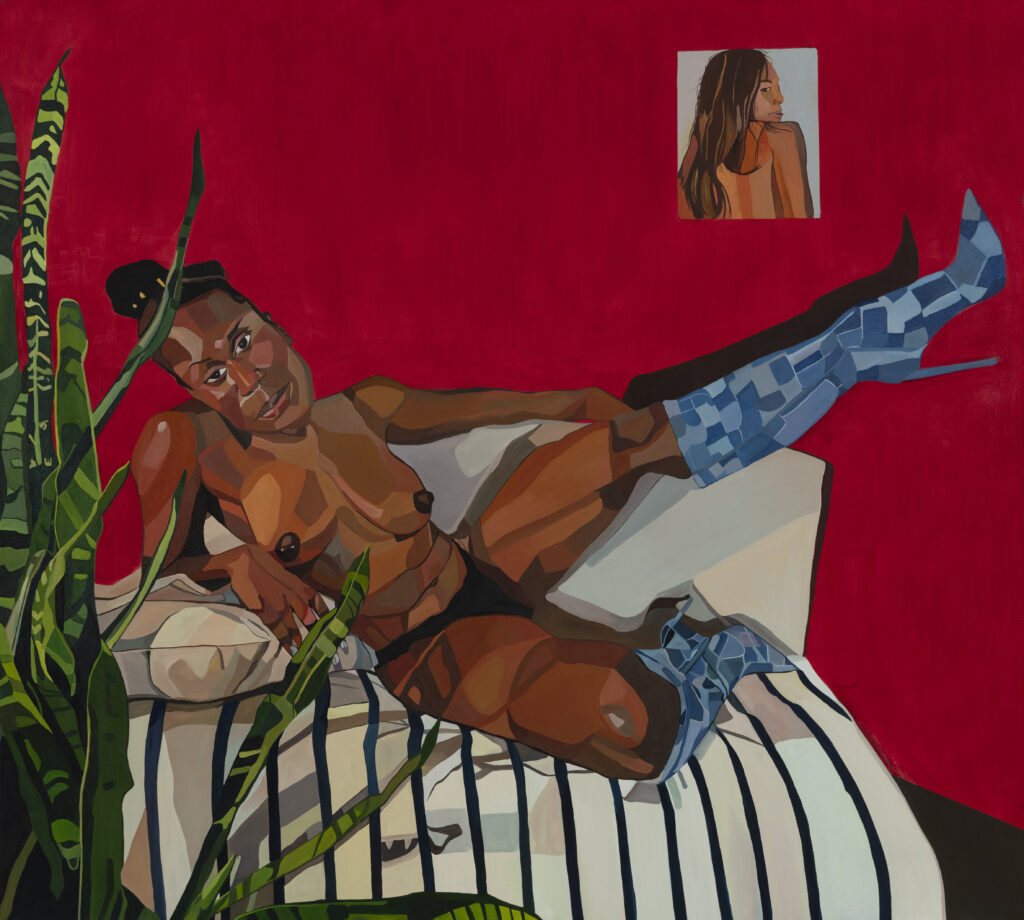
There’s a more energetic and playful quality to other works, including ‘Denim and Desire’, 2025, in which a reclining woman shows off her pair of knee high denim boots, painted a mosaic of varied blues, while staring directly at the viewer. Although removing them from objectification, Labinjo doesn’t deny her sitters sexuality, which is embodied in fashion here.
A highlight of the exhibition, this painting has symbolic elements for the viewer to engage with. In the background is a small self-portrait of the artist, a painting within a painting, which hangs on the wall. Below, the woman’s naked body is striped with the shadows of a green houseplant, which stands in the foreground, a reference to Lucian Freud who made many portraits of these specimens.
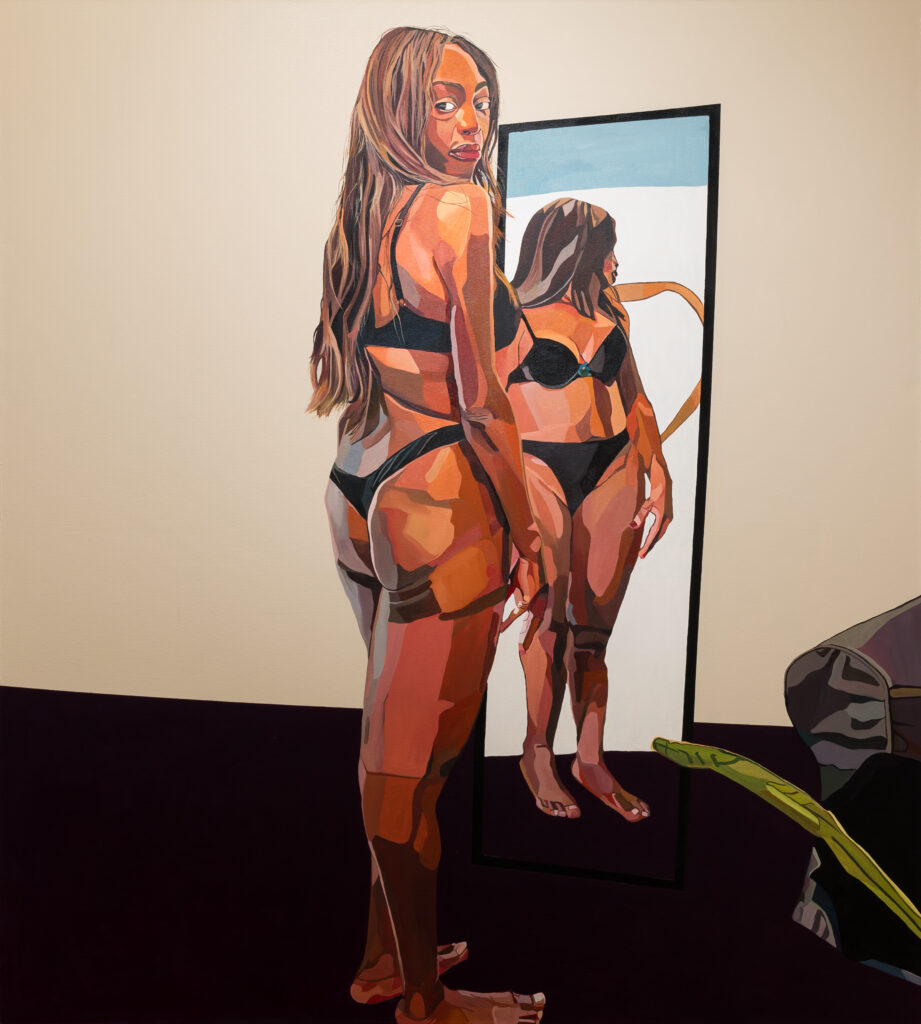
Populating one wall are Labinjo’s own small plant portraits, adding to the welcoming tone of this show, which riffs on art history’s traditions. The plant again creeps into the corner of another canvas, ‘Self-Portrait (Reflection)’, 2026, in which the artist has painted her own image at greater scale.
Playing with another device, that of the mirror, the artist turns away from her reflection: is she less interested in her appearance than confronting the viewer? It’s as if she’s asking her audience to consider their own act of looking, depictions of Black women, and the experience of seeing and being seen.
This defiant work echoes the oversized pastel drawings of Claudette Johnson, who has often taken herself as her own muse. A member of the pioneering BLK Arts Group, who formed in Wolverhampton, she continues to depict Black figures with presence and power.
Johnson has work in Wolverhampton Art Gallery’s permanent collection, as has Turner Prize-winning Lubaina Himid; their Black feminist visions have directly influenced Labinjo who wrote her MFA dissertation on their practice.
For Senior Curator Sanna Moore, this meaningful connection underpins the programme:
“As we continue to grow the Black Art Collection both Joy Labinjo’s show, and Shaqúelle Whyte’s upcoming exhibition, celebrate a new generation of young Black British artists who have great energy and focus.”
In the hands of artists like Labinjo, the future of figurative painting is fresh and exciting. Undressing historical tropes of the nude with her flat brush and bold palette, she draws on dichotomies: intimate scenes are re-imagined at large-scale, private moments made public, and her radiant sitters pictured in flat yet sculptural terms, taking up space with their presence.
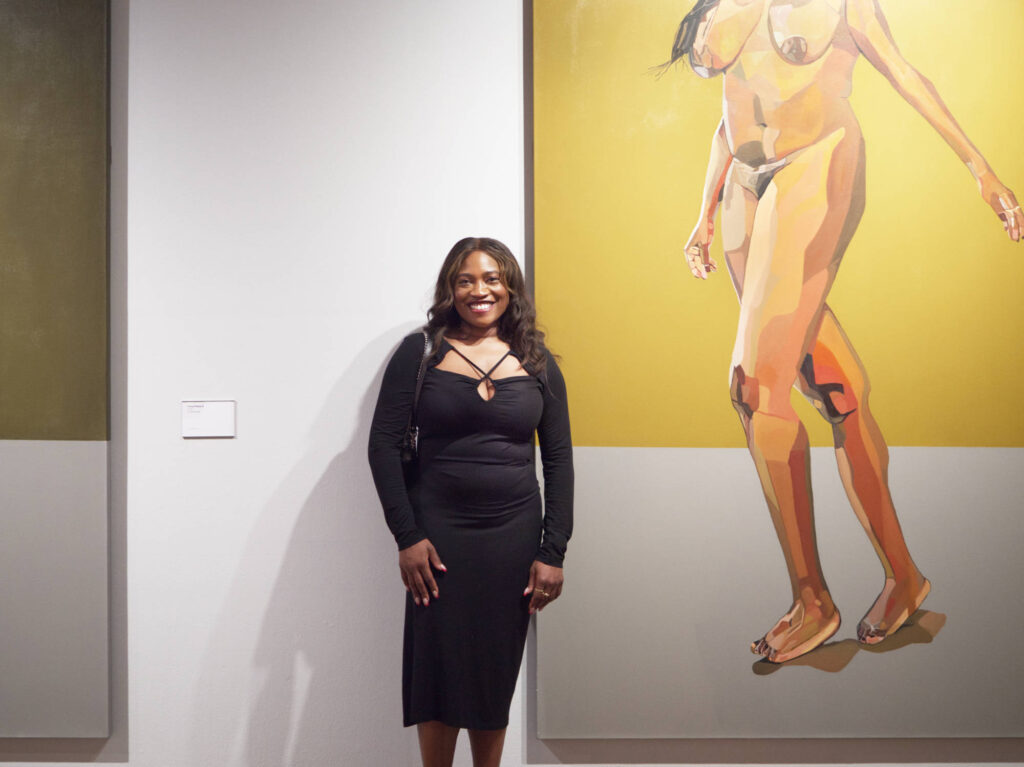
Joy Labinjo: A Place of Our Own at Wolverhampton Art Gallery runs until Monday 4 May. Wolverhampton Art Gallery is free to visit Monday to Saturday (10.30am to 4.30pm) and Sunday (11am to 4pm). Glaze café is open Monday to Saturday (10.30am to 4pm) and Sunday (11am to 3.30pm). For more information visit Wolverhampton Arts and Culture.